Both calcined alumina and tabular alumina are alpha-Al2O3 (corundum phase), but the difference in their production process leads to dramatically different microstructures and end-use performance. Choosing the wrong grade is one of the most common procurement mistakes in the refractory and ceramics industry.
calcined alumina in ceramic glazeCalcined alumina is produced by heating aluminum hydroxide to 1,200 to 1,400 degrees C, producing fine, porous alpha-Al2O3 particles with high surface area. Tabular alumina is produced by sintering at 1,650 to 1,750 degrees C, producing dense, plate-like (tabular) crystals with very low porosity and high thermal conductivity.
At Aluminaworld, we manufacture both grades from a single integrated line in Shandong. The decision matrix below reflects customer feedback across 15 years of supplying over 5,000 MT/year combined to refractory, ceramic, and polishing customers.
1. Production Process and Microstructure
Calcined Alumina
Aluminum hydroxide (gibbsite or boehmite) is heated in rotary kilns or fluidized bed calciners to 1,200 to 1,400 degrees C. The transformation sequence: gibbsite to chi-alumina to kappa-alumina to alpha-alumina. The resulting particles are porous (40 to 50% intra-particle porosity) with surface area 1 to 5 m2/g for the dense grades and up to 80 m2/g for reactive grades.
Tabular Alumina
Calcined alumina is re-sintered at 1,650 to 1,750 degrees C, often with the addition of a small amount of boron oxide or similar mineralizer to accelerate densification. The tabular (plate-like) crystal structure develops, with intra-particle porosity dropping below 5% and surface area falling to 0.5 to 1.0 m2/g. Bulk density rises from 0.85 g/cm3 (calcined) to 1.0 g/cm3 (tabular).
Key Property Comparison
| Property | Calcined Alumina | Tabular Alumina |
|---|---|---|
| Al2O3 purity | 99.0 to 99.7% | 99.5 to 99.8% |
| Bulk density | 0.85 g/cm3 | 1.0 g/cm3 |
| Surface area | 1 to 80 m2/g | 0.5 to 1.0 m2/g |
| Thermal conductivity | low to moderate | high |
| Reactivity with binders | high | low |
| Price (relative) | 1.0x | 1.5 to 2.0x |
2. When to Choose Calcined Alumina
Calcined alumina is the right choice when you need:
- Reactivity with ceramic binders. The high surface area promotes sintering at lower temperatures. For refractory castables and ceramic glazes fired at 1,400 to 1,500 degrees C, calcined alumina gives full densification.
- Fine particle sizes. Calcined alumina can be milled to sub-micron sizes (D50 below 1 micrometer) for use in polishing compounds and high-gloss glazes. Tabular alumina is much harder to mill fine.
- Lower cost. For applications where the performance of tabular is not required, calcined alumina saves 40 to 50% of material cost.
- High purity with controlled soda content. Low-soda grades (Na2O below 0.1%) are used in electronic ceramics and high-temperature insulators.
Specific applications: ceramic glazes, polishing compounds, paints and coatings, plastic and rubber fillers, low-voltage insulator bodies, and thermal spray powders.
3. When to Choose Tabular Alumina
Tabular alumina is the right choice when you need:
- High thermal conductivity. The dense tabular structure conducts heat 5 to 10x better than porous calcined alumina. Critical for refractory applications where heat transfer matters (steel ladle linings, coke oven doors).
- Thermal shock resistance. Dense tabular particles resist thermal cycling better than porous calcined. Tabular-based castables last 2 to 3x longer in cyclic service.
- Low creep at high temperature. The fully densified structure has very low creep rate under load at 1,600 degrees C. Essential for high-temperature furnace furniture.
- Chemical resistance. The non-porous structure is less susceptible to slag penetration in iron and steel applications.
Specific applications: high-performance refractory castables, precast shapes for steel and cement industries, kiln furniture, burner nozzles, and foundry applications.
Common Blends
Many refractory formulations blend both grades to balance cost and performance. A typical steel ladle castable might use 60% tabular (for thermal shock resistance) and 40% calcined (for sintering and cost). Our technical team can help optimize your blend.
Frequently Asked Questions
What is reactive alumina?
Reactive alumina is a sub-category of calcined alumina with very fine particle size (D50 below 1 micrometer) and high surface area (50 to 80 m2/g). It sinters at temperatures as low as 1,300 degrees C and is used in high-density ceramic bodies and polishing.
What is white fused alumina vs tabular alumina?
White fused alumina (WFA) is made by melting calcined alumina in electric arc furnaces at 2,000 degrees C+, then crushing. It is even denser than tabular but more expensive. Used in premium abrasives and high-performance refractories.
Which is better for high-alumina castables?
Tabular, because the dense structure resists slag penetration and thermal shock. A castable with 85 to 95% tabular alumina is the industry standard for steel ladles.
Can I substitute calcined for tabular?
Only in low-temperature (below 1,400 degrees C) and non-critical applications. The performance gap widens with temperature and mechanical stress.
Do you supply custom mesh sizes?
Yes, from 200# (74 micrometer) to 5000# (2.6 micrometer) for calcined, and 8# to 325# for tabular. Custom packaging available above 1 MT orders.
Related Alumina Powder Articles
Alumina Powder in Ceramic Glaze: Improving Hardness and Thermal Shock Resistance
Alumina Powder as Paint Filler: Abrasion Resistance and Anti-Slip Coatings
High Purity Alumina (HPA) for Lithium Battery Separator Coating: 4N vs 5N
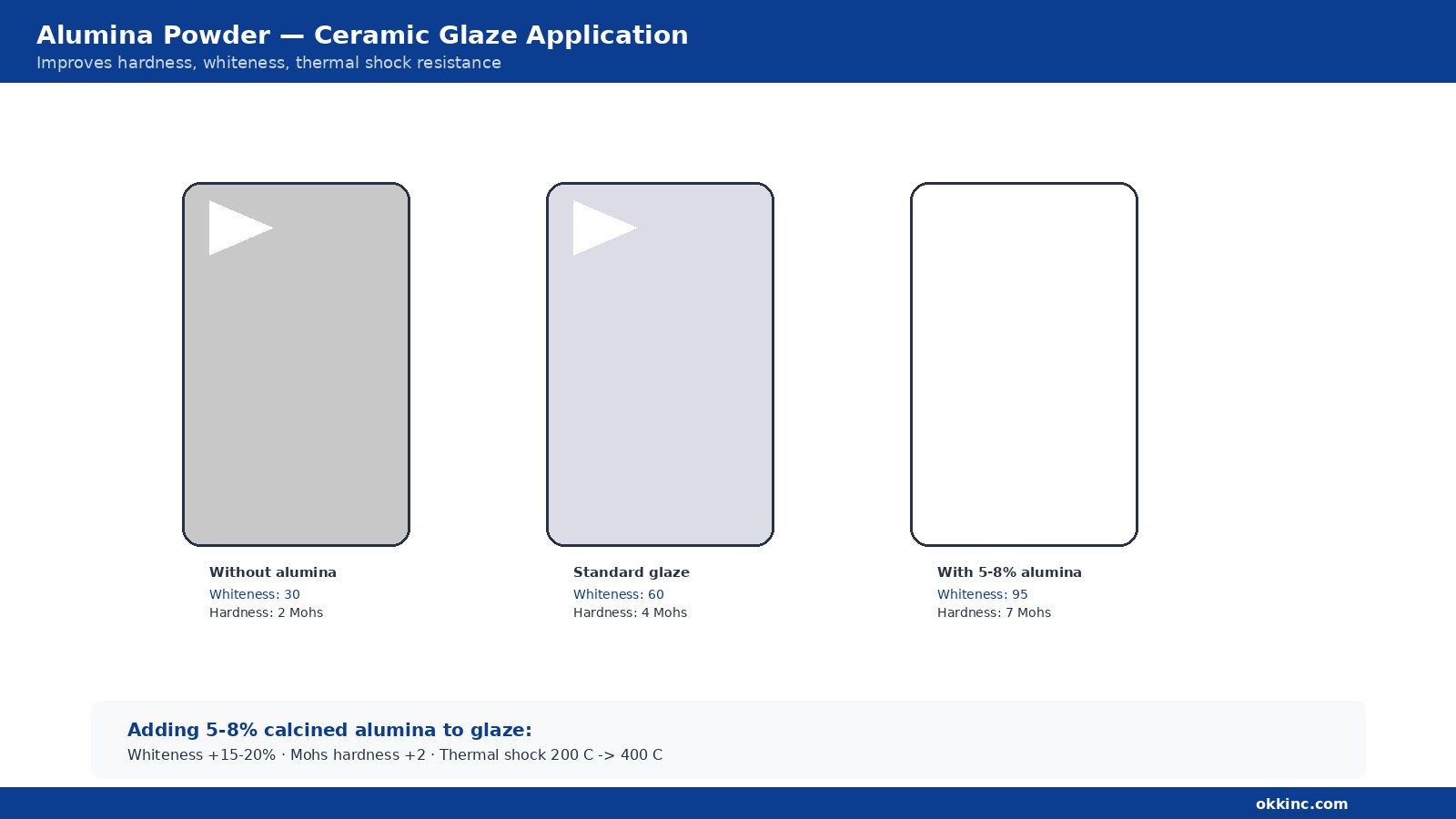
calcined alumina in ceramic glaze
high purity alumina for battery separator
Molecular Sieve 3A Application Guide
Need a Quote or Free Sample?
Tell us your feed conditions and target outlet spec. Our engineers reply within 24 hours with a recommendation and a 1 kg free sample.