Regeneration accounts for 60 to 70% of lifetime operating cost in a molecular sieve adsorption system. Get it right and you will see 7 to 10 years of bed life; get it wrong and you can lose 30% of working capacity within 12 months. The most common failure modes are surprisingly basic: wrong temperature, wrong flow direction, or simply too short a hold time.
complete regeneration best practicesIn this guide we cover the three regeneration modes (TSA, PSA, and combination), the temperature targets for each molecular sieve grade, and the field data we collect from our customer base to verify that a regeneration cycle is actually working.
Whether you operate a 100 L/hour laboratory unit or a 100,000 Nm3/hour hydrogen plant, the physics is the same. The differences are scale, insulation, and how aggressively you can swing the cycle.
1. Three Regeneration Modes Explained
1. Temperature Swing Adsorption (TSA)
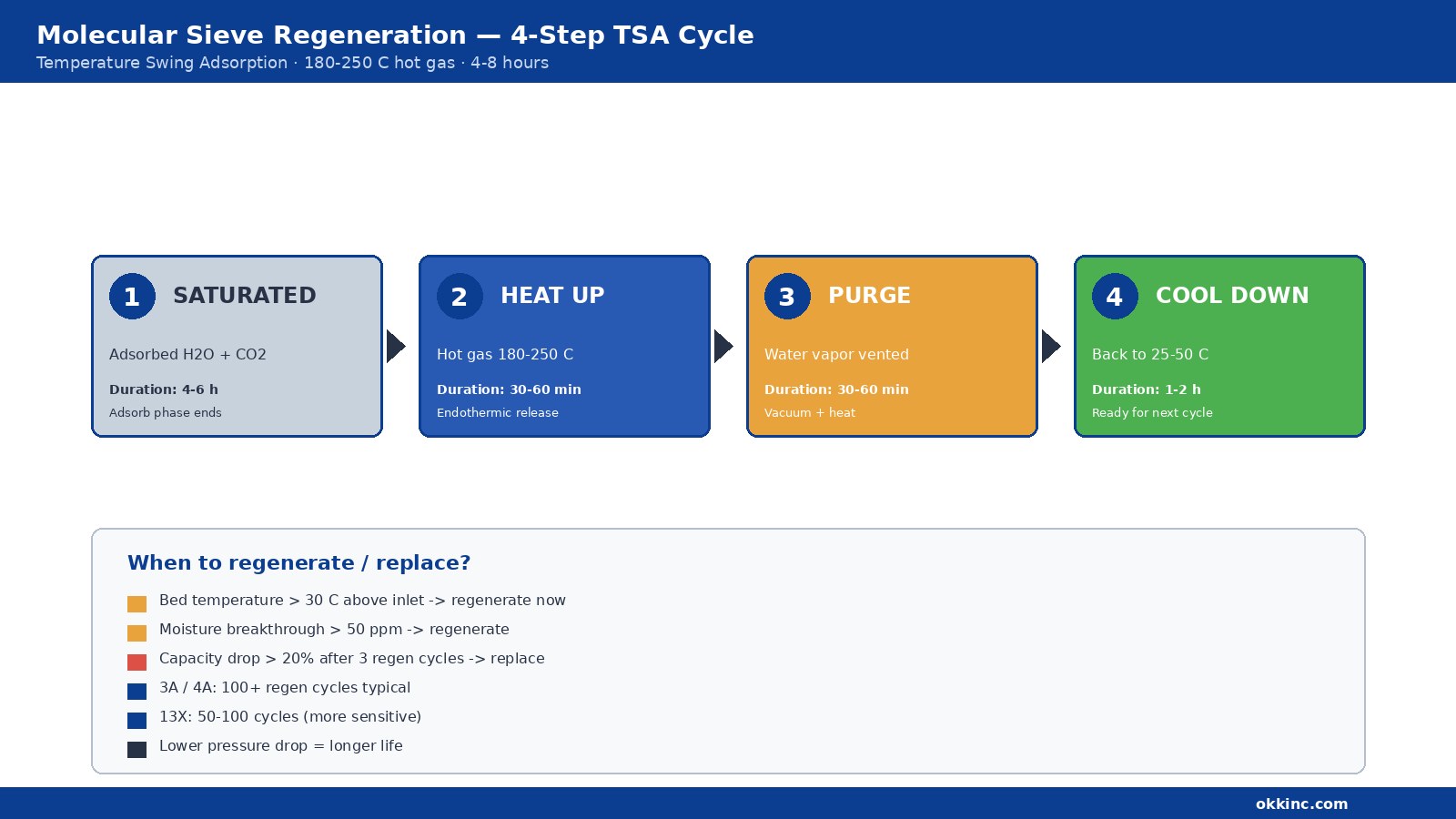
The workhorse method for most processes. The bed adsorbs at low temperature (20 to 50°C) and regenerates at high temperature (200 to 300°C). Cycle times: 4 to 24 hours. Best for: deep water removal (sub-ppm outlet), high-purity gas processing.
2. Pressure Swing Adsorption (PSA)
The bed adsorbs at high pressure (5 to 80 bar) and regenerates at low pressure (1 to 2 bar, sometimes with vacuum assist to 50 mbar). Cycle times: 30 seconds to 15 minutes. Best for: bulk gas separation (H2, O2, N2), high-volume but lower-purity applications.
3. Combination (Rapid PSA with Thermal Assist)
A hybrid approach used in some hydrogen and ethylene plants: rapid PSA cycle (5 to 10 minutes) for bulk removal, with a periodic thermal pulse to remove heavy contaminants that accumulate in PSA-only operation. Useful when feed has variable composition.
2. Temperature Targets by Sieve Grade
Selecting the right regeneration temperature is the single highest-impact decision in sieve operation. Too low and you leave water adsorbed, reducing capacity on the next cycle. Too high and you risk thermal damage to the crystal structure.
| Sieve Grade | Optimal Regen Temp | Maximum Safe Temp | Hold Time |
|---|---|---|---|
| 3A | 220 to 260°C | 280°C | 2 to 4 hours |
| 4A | 250 to 280°C | 300°C | 2 to 4 hours |
| 5A | 250 to 280°C | 300°C | 2 to 4 hours |
| 13X | 240 to 270°C | 290°C | 2 to 4 hours |
Going above the maximum safe temperature causes cation migration in the zeolite framework. For 3A, this means potassium ions move to non-exchange sites, effectively shrinking the pore opening and reducing capacity. For 13X, sodium migration can change the effective pore size and selectivity. Either case is irreversible; the only fix is sieve replacement.
3. Verifying Your Regeneration: Three Field Tests
If you suspect your regeneration cycle is leaving capacity on the table, here are three tests you can run in under an hour.
Test 1: Outlet Dew Point at End of Adsorption
Install a chilled-mirror hygrometer at the bed outlet. Run a normal cycle and record the outlet water content in the last 5 minutes of adsorption. If it rises above 50% of inlet spec, the bed is under-regenerated. Increase hold time by 30 minutes or raise regen temperature by 20°C.
Test 2: Regeneration Gas Outlet Temperature Profile
Place a thermocouple at the regeneration gas outlet. The outlet temperature should rise to within 30°C of the heater inlet temperature within the hold phase. If it plateaus 50°C below inlet, you have a heat transfer problem, usually inadequate flow or insulation.
Test 3: Bed Pressure Drop Trend
Track differential pressure across the bed each cycle. A rising trend indicates fines accumulation, screen blockage, or bed settlement. A stable value confirms mechanical integrity of the sieve charge.
If you share the data from any of these tests with our technical team, we can model the regeneration cycle and recommend specific adjustments within 48 hours.
Frequently Asked Questions
How long does it take to fully regenerate a saturated bed?
A typical industrial bed takes 4 to 6 hours for a complete regeneration cycle: 60 to 90 min heat-up, 2 to 4 h hold, 60 to 90 min cool-down. Forced cooling with a heat exchanger can cut this by 30%.
Can I use dry compressed air instead of N2 for regeneration?
Yes, but only if the air is oil-free and dried to -40°C dew point or better. Oil contamination above 0.1 ppm will foul the bed; wet air adds to the regeneration load.
What happens if regeneration is interrupted mid-cycle?
Most plants can handle short interruptions (under 30 min) by extending the hold phase when the heater resumes. Longer interruptions can leave the bed in a partially loaded state, reducing the next adsorption cycle.
Is there a way to speed up regeneration?
Vacuum-assisted TSA reduces hold time by 30 to 45% with minimal energy penalty. Microwave-assisted regeneration is in pilot stage but not yet commercial for large beds.
How do I know when my regeneration heater is undersized?
If the bed fails to reach target temperature within 60% of the cycle time, the heater is undersized. Calculate required duty as: bed mass times specific heat times (T_target minus T_feed) plus 10% for losses.
Related Molecular Sieve Articles
Molecular Sieve 3A: Ethanol Dehydration and Insulating Glass Applications
Molecular Sieve 4A for Natural Gas and LNG Dehydration: Capacity and Cycle Design
Molecular Sieve 5A vs 13X in PSA Hydrogen Purification: Which Grade Wins?
complete regeneration best practices
molecular sieve poisoning symptoms
Activated Alumina Vs Silica Gel Desiccant
Need a Quote or Free Sample?
Tell us your feed conditions and target outlet spec. Our engineers reply within 24 hours with a recommendation and a 1 kg free sample.