This guide is for the procurement engineer or category manager who has been quoted a minimum order quantity for molecular sieve or activated alumina and now has to decide whether to accept it, move it, or restructure the order around it. The question sounds purely commercial, but in adsorbent supply it is really about freight geometry, working capital and shelf-life risk, and those three respond to order size in different directions. That is why a 25 MT order is frequently cheaper for a plant with stable consumption, and why the same 25 MT is expensive for a distributor with volatile demand. The numeric examples below use industry-typical inputs for freight, price breaks and carrying costs, offered as a framework to argue from rather than as a quotation.
What an adsorbent MOQ actually is, and why the quoted number is rarely the real constraint
Three different things get called the minimum order quantity in this industry, set by three different functions inside the supplying factory. The first is the production campaign minimum: below a certain tonnage the mill cannot amortise a kiln firing or screening run, so the factory will not schedule the order at all. The second is export shipment economics: below roughly one container equivalent the order will not carry the ocean freight, terminal handling and documentation cost per tonne that a full container amortises, so the factory either declines it or prices it so aggressively that it loses interest in filling the container. The third is the brand-owner minimum: if you ask for private-label bags or a pre-printed carton, the print setup and minimum run length is frequently larger than the production minimum itself.
Ask which of the three is actually binding, because each has a different negotiable response. A production campaign minimum usually moves when you consolidate grades or accept a shared campaign. An export economics minimum usually moves when you accept a different Incoterm or ship in a part-container. A brand-owner minimum almost always moves when you take the factory standard pack, the highest-leverage concession available in most adsorbent negotiations and one that costs the factory nothing.
There is a fourth constraint that never appears on the quotation: the packing round. Most adsorbent is supplied in 25 kg bags, and a factory will not ship a fractional pallet, so the real increment you can buy is 25 kg multiplied by a whole number of bags multiplied by a whole number of pallets. A factory quoting "18 MT" is usually quoting eighteen and a bit tonnes that they will round to the nearest workable bag count. Agree the rounding rule in the contract before you compare two quotes.
The three cost drivers that decide whether a smaller order is genuinely cheaper
An order-quantity decision comes down to three numbers that move in opposite directions as tonnage falls. The first is unit price and its volume break: the ex-works price per tonne falls as the order rises, typically 3 % to 8 % between a part-container order and a multi-container order, and beyond a certain campaign size the curve flattens because the freight and documentation savings have already been captured. The second is landed cost per tonne, dominated by ocean freight, terminal handling, insurance and customs clearance. The third is the cost of carrying the material in your own operation: capital tied up, warehouse space consumed, quality risk of long storage and the administrative cost of a larger receipt.
The counter-intuitive part is that landed cost per tonne is not a smooth function of your order size. Below the point where the shipment fills a container, landed cost per tonne rises sharply because you are paying for the whole container and shipping less in it. Above that point it falls, because each additional container is fully utilised. Above about a full container it flattens again, because the next container you add is another whole container. The freight argument for a large order is therefore about whether you are paying for one container or two. If both candidate orders fit inside one container, the freight difference is essentially zero, and the decision reduces to the factory price break on one side and your carrying cost plus shelf-life exposure on the other.
Freight: why an 18 MT order usually still costs you a full container
Adsorbent is a dense, low-value, moisture-sensitive cargo, normally moved as a dry bulk in a lined container or as palletised bags, with material density determining how much of the container you can use. For 8x12 mesh 13X or 3A the loose bulk density typically sits between 0.60 and 0.70 kg/l, for 2 to 5 mm activated alumina between 0.65 and 0.80 kg/l, and for calcined alumina powder and pseudo-boehmite powder often 0.40 to 0.60 kg/l. Those ranges are industry-typical rather than factory-specific, but they are enough to size the container question before you quote freight.
Apply a practical fill factor. Palletised bagged adsorbent in a conventional dry box typically occupies 55 % to 65 % of the gross container cube, because of pallet overhang, dunnage, the void at the door end and the fact that bags are not a rectangular stack. Bulk-lined loading of free-flowing pellets achieves 80 % to 90 % of cube.
| Container | Gross cube | Bagged fill factor | Payload at 650 kg/m3 | 25 kg bag equivalent |
|---|---|---|---|---|
| 20 ft standard (20GP) | 33.2 m3 | 55 to 65 % | 11.9 to 14.0 MT | 476 to 560 bags |
| 40 ft standard (40GP) | 67.7 m3 | 55 to 65 % | 24.2 to 28.6 MT | 968 to 1,144 bags |
| 40 ft high cube (40HC) | 76.4 m3 | 55 to 65 % | 27.3 to 32.3 MT | 1,092 to 1,292 bags |
| 40 ft high cube, bulk lined | 76.4 m3 | 80 to 90 % | 39.7 to 44.7 MT | Bulk, not bagged |
Read that table with a 25 MT order in mind and the freight picture becomes clear. An 18 MT order of 8x12 mesh 13X in bags will very often be stuffed into a 40 ft standard box only about 67 % full. The container cost is the same as it would be for a 27 MT load, so freight per tonne rises from roughly 96 to about 133 US dollars on a typical Asia to Europe or Asia to Middle East lane at 2,400 US dollars per container. That is a difference of around 37 US dollars per tonne on a large order, which is real money but frequently smaller than the inventory cost of the extra seven tonnes. The same logic applies to a 20 ft container, where the waste is worse: an 18 MT order does not fit a 20GP of bagged molecular sieve at all, so the buyer who wants "just under a container" commits to a full container anyway. The exception is groupage, where the freight rate per cubic metre is several times higher.
One freight variable is routinely left out: the container specification itself. Container dimensions referenced to ISO 1496-1 and load performance described in ASTM D4169 both influence what the carrier will accept for a given packing density, and a density declaration wrong by more than about 5 % can trigger a cargo clarification request or a refused container at the load port. For dense cargo such as bagged 13X at 650 kg/m3 on pallets, declaring the correct gross mass under ISO 780 for complete, filled transport packages is what stops your container being held at the terminal. Our container loading optimisation for 20 ft and 40 ft boxes covers the geometry, and density versus vessel hold capacity across adsorbents shows why the same 25 MT occupies very different volume.
Working capital: the cost the buyer is most often not counting
The inventory effect of a larger order is straightforward and routinely omitted. If you consume at a steady rate, average inventory is approximately half the order quantity plus your safety stock. Raising the order from 18 MT to 25 MT raises cycle stock by 3.5 MT, and on a typical 13X ex-works price around 600 US dollars per tonne that is roughly 2,100 US dollars of additional capital tied up in the warehouse. Carry that at a 25 % annual rate covering capital, insurance, shrinkage and obsolescence and you are looking at around 500 US dollars per year, which is where most buyers stop.
It is the wrong number to stop at, because capital cost is only the visible part of carrying seven extra tonnes. Storage is the part that varies most between buyers and it is where the decision turns. A contract distributor paying per pallet position per month can easily see a warehouse cost on the extra volume that exceeds the price break the factory offered. A plant with dedicated bulk silo capacity, receiving directly into the hopper, effectively pays nothing for storage.
Then there is shelf-life exposure, which most changes the answer for adsorbent specifically. Molecular sieve and activated alumina are manufactured to hold water and hold it from the moment they are made, so their useful life in storage is governed by packaging integrity and ambient humidity rather than by any inherent expiry date. Long-stored material that has absorbed moisture does not fail suddenly; it simply delivers less working capacity, which on a PSA or a purification bed means shorter cycles, earlier bed change-out and a creeping loss of product quality that nobody detects until operating data is compared against the design basis. The point is not that a seven-month-old bag of 13X is worthless; it is that the buyer holding that inventory carries a risk the buyer who consumes in three months does not, and that deserves to be priced.
| Carrying-cost element | 18 MT order | 25 MT order | Comment |
|---|---|---|---|
| Peak capital at goods-invoice | 10,800 USD | 15,000 USD | At an indicative 600 USD/MT ex-works |
| Average inventory, 4 week safety stock | 13.0 MT | 16.5 MT | Half order plus safety stock |
| Annual capital and insurance charge at 25 % | 1,950 USD | 2,475 USD | 525 USD per year of the delta |
| Warehouse positions held | 14 pallet positions | 20 pallet positions | Only if space is charged per position |
| Receiving, inspection and QC admin | One event | One event | No difference for a single container |
| Shelf-life exposure at consumption rate | Shorter dwell | Longer dwell | Qualitative, often decisive |
The practical conclusion is that the smaller order wins on capital and storage but the swing is small, whereas the swing on shelf-life exposure is large and is not captured by any of these figures. That is the argument to make when you want a smaller lot, and it is much stronger than a comparison of two prices per tonne. If your consumption is uncertain, your case is not that 18 MT is cheaper, it is that 18 MT limits the quantity that can sit in your warehouse for eleven months while your forecast proves wrong.
How to read the factory price break, and where the money actually is
The factory quotation for industrial adsorbent typically presents a price per tonne that changes across a small number of bands. For a 3A or 13X order from a Chinese manufacturer the bands you will most often see are something like 15 to 18 MT, 18 to 25 MT, 25 to 40 MT, and above 40 MT, with the ex-works price falling at each step. The absolute numbers vary with grade, mesh size, packaging format and market, but the structure is stable enough to plan around. The important observation is that the step into the band above yours is often worth more than the step into the band above that. A 3 to 5 % gain from the next band is worth chasing; a further 1 % usually is not.
Two things sit outside the price band and both are worth more than the band itself, so they should be negotiated in parallel rather than sequentially. The first is packaging format. Standard factory packing for export is a 25 kg bag, kraft-paper multilayer for dry grades or aluminium-plastic laminate for the more sensitive products. Custom bag printing, a private-label outer carton or a customer-specified barcode each carries a setup cost and a minimum run quantity. If your order is at the MOQ because of a print run length rather than the mill, dropping to the factory standard format removes that constraint entirely and typically returns 3 % to 5 % of price.
The second is the Incoterm. Moving from EXW to FOB or CIF does not change the factory's ex-works price, it changes who carries the risk and cost of the international leg, and it changes total landed cost even though the quoted unit price looks identical. An EXW quotation puts the whole shipping arrangement on you, which for a first-time buyer means carrier quotations, a freight forwarder, an export declaration in China, insurance and customs clearance in your country, and the risk that the container sits at the port while documents are corrected. Our FOB versus CIF versus DDP comparison for adsorbents under Incoterms 2020 works through the risk allocation, and the Incoterms 2025 cost model shows how cash-flow and risk change with each choice.
A third item is often treated as a detail and is not one: payment terms and the discount for paying earlier or on time. An unremarkable 2 % to 3 % discount for payment against copy of the bill of lading is worth more to the factory than the difference between two adjacent price bands, and costs you nothing beyond arranging the documentation. If you currently pay by irrevocable letter of credit at sight, ask what the price would be on cash against documents. Our guide to the top seven letter of credit documentation discrepancies covers the cost of getting the documentary terms wrong.
Six levers that move the MOQ without moving your budget
These are the specific, repeatable levers that work in adsorbent supply, ordered by how much they move the achievable minimum. Each changes something structural about the order rather than simply paying more for the same structure.
1. Drop the custom packaging and take the factory standard
This is usually the highest-yield single concession available. The factory carries the setup cost and the minimum run length; you carry the packaging specification, which for most applications is a 25 kg laminated bag with a printed grade, batch and net weight marking. If your incoming inspection uses the bag marking and the COA, you do not need your own print.
2. Consolidate grades into one campaign
A factory running two grades in one production campaign can schedule them together and split the campaign cost; a factory running two grades in two campaigns cannot. If you buy 3A and 13X in similar quantities, ask whether they can be produced in a single campaign or a single screening and packaging run. This is often accepted because the incremental cost of a second grade in an existing campaign is low, and it can drop your combined minimum to your largest single grade rather than the sum of both.
3. Accept a split delivery against one order
This is the most underused lever in the category and it is available far more often than buyers realise. A 25 MT order released as 15 MT now and 10 MT in six weeks satisfies the factory's production minimum because the total commitment is 25 MT, while giving you the working-capital and shelf-life profile of the smaller order. Your invoice can be a single proforma with two shipments and the price negotiated as though it were a single 25 MT campaign. The only real cost is two receiving events and two sets of export documents.
4. Convert bags to bulk lined loading
As the container table shows, bulk lined loading raises the payload of a 40HC from about 27 to 32 MT into the 40 to 45 MT range for a free-flowing pellet. That changes the tonnage-per-container arithmetic and can move you into a better price band on a smaller order. It is not available for powder grades or where particle shape must be preserved to avoid attrition, but for 3A, 5A and 13X in pellet or bead form it is a routine request.
5. Negotiate the band, not the MOQ
Sometimes the MOQ is genuinely firm and the price band is genuinely negotiable, and it is worth asking directly. The most common outcome is a price concession at the quoted minimum, the same economic result as a lower minimum at the quoted price. Ask what the price would be at the MOQ: if the quoted price already reflects a premium for the smaller commitment, that premium is the number to attack. The mechanics are covered in our industrial adsorbent RFQ checklist covering seven metrics.
6. Commit to a forward schedule instead of a single order
If your consumption is steady and forecastable, ask whether the factory will hold the quoted minimum against a forward commitment of two or three shipments over six or nine months, each released against your call-off schedule. This is the standard way large industrial buyers handle the same problem. The factory gets a predictable production slot; you get the small-order price on a large-order basis. The risk is a price-fix expiry date and a volume commitment, so agree both explicitly.
When 18 MT is the right answer, and when 25 MT is
The decision reduces to a small number of buyer archetypes, and it is worth being honest about which one you are rather than running a spreadsheet that will give you whichever answer you already prefer. A plant with steady consumption, direct-to-hopper receiving and bulk silo capacity should take the larger order: the price break is real, storage cost is effectively nil, and the shelf-life question largely disappears because turnover is fast. A distributor with volatile demand, no silo, a small warehouse and thin cash should take the smaller order, accepting a modest price penalty as the price of not being stuck with eleven months of stock that has quietly absorbed moisture. The middle case is resolved by the split delivery.
| Buyer profile | Recommended quantity | Primary lever | Trade-off to accept |
|---|---|---|---|
| End-user plant, steady consumption, silo receiving | 25 MT and above | Price band, bulk lined loading | Longer replenishment interval |
| Distributor, volatile demand, shared warehouse | Minimum, single delivery | Standard packaging, payment discount | Higher unit price |
| Project buyer with a dated completion | Sized to the project schedule | Split delivery, campaign consolidation | Possibly a higher per-tonne price |
| Multi-grade buyer below MOQ on each grade | Sum across grades, one campaign | Grade consolidation | One grade may need to be bought elsewhere |
| First-time buyer with no track record | One container, standard pack | Build credit with a paid sample first | Smallest discount |
One more case is common and frequently mishandled: a buyer whose requirement is genuinely below any export MOQ. If you need three tonnes, no negotiation will produce three tonnes at export economics, and the honest answer is that the supply route is wrong rather than the order size. At that volume you buy from a local distributor holding stock, and the value is availability rather than price.
The commercial terms that make a reduced quantity acceptable to both sides
An MOQ conversation is easier when the quantity reduction is offset by terms the supplier values. There are four that work reliably. The first is the forward commitment: a firm total tonnage with a call-off schedule converts a one-off order into a planned campaign, worth more to a factory than the equivalent single-order discount. The second is a shorter lead time: if you can commit to releasing the order within two working days of the proforma invoice rather than three weeks, you remove a real source of scheduling risk and the factory will usually reflect that in the price. The third is reduced payment risk: moving from an irrevocable letter at sight to cash against documents improves the supplier's cash cycle and is often cheaper for you than a price concession. The fourth is the simplest and the most overlooked: a repeat-order history. Suppliers price their risk of a new buyer on the probability of a second order, and evidence that you have taken delivery before and paid on time is worth a price band in a way a volume promise is not.
The terms to resist are the ones that transfer risk without transferring money: extended payment terms without a corresponding price benefit, a unilateral right for the supplier to substitute a different production campaign, an acceptance clause that ties acceptance to arrival of the material rather than arrival of the documents, or a quality claim window that expires before the material could reasonably have been put into service. Our FIBC versus steel drum total-cost decision model with an 18-month storage spreadsheet shows the same storage-driven decision applied to packaging.
Size the order to whole bed loads, not to your consumption rate
The order quantity should be sized against your bed geometry, not against your consumption rate alone, because this calculation resolves a surprising number of otherwise difficult negotiations. If your adsorber beds hold, say, 4.5 MT of 13X each and you take a 25 MT order, you are committing to nearly six bed loads. If your service life on those beds is 24 months, then 25 MT is exactly two and a half bed change-outs, which leaves an awkward 50 % of a bed at the end of the cycle and creates the problem of a partially used bed sitting in the vessel because it is not worth swapping. The clean answer is to size the order to a whole number of bed loads and align it with the replacement schedule. That arithmetic is often the reason a nominally attractive larger order is actually a poor fit, and it reframes the negotiation: a buyer who can say they need 22.5 MT because that is five complete bed loads of 4.5 MT is making a technical argument, and technical arguments are far easier to accommodate than a general request for a discount.
Frequently asked questions
Is a 25 MT order always cheaper than an 18 MT order for molecular sieve?
No. A 25 MT order is cheaper only when the price break exceeds the additional landed and carrying cost of the extra seven tonnes. The price break typically runs 3 to 8 % between adjacent bands, while the extra inventory cost for seven tonnes is usually well below that. But 18 MT of bagged 8x12 mesh in a 40 ft container often leaves it only two-thirds full, so freight per tonne is materially higher on the smaller order. For a plant with direct-to-silo receiving and steady consumption the larger order usually wins; for a distributor with uncertain demand the smaller one usually does.
What is the typical minimum order quantity for industrial adsorbent from a Chinese manufacturer?
For a standard export order in 25 kg bags, the practical minimum is normally one 40 ft container equivalent, which for 8x12 mesh grades sits in the region of 24 to 28 MT depending on bulk density and packing method. Some factories quote a lower figure such as 15 or 18 MT and load the balance of the container with other customers' material, so the quoted number and the loaded quantity are not the same thing. Ask what the minimum is expressed in bags or pallets rather than in tonnes.
Can I get a lower MOQ by asking the supplier to split the delivery?
You can usually get a lower quantity per delivery rather than a lower total order. A factory minimum is almost always the total tonnage committed to one production and packaging campaign, not the tonnage that must arrive in one container. Agreeing a 25 MT order released as two shipments of 15 MT and 10 MT six weeks apart satisfies the production constraint while giving you the working-capital profile of the smaller option. Confirm in the proforma that the price is set on the total tonnage.
Does dropping custom printed packaging actually reduce the MOQ?
Frequently yes, because print setup and minimum run lengths are a common source of a stated minimum that has nothing to do with production. A private-label bag or carton carries a plate setup cost and a minimum run quantity that can exceed the mill's production minimum. Accepting the factory standard pack removes that constraint and typically returns 3 % to 5 % of price, making it the highest-yield single concession in most adsorbent negotiations. Request samples of the standard pack first.
How much does the Incoterm change the true cost of a smaller order?
Considerably, and it is frequently the largest single variable after the unit price. Moving from EXW to FOB or CIF does not change the factory's ex-works price, but it changes who pays for and carries the risk on the international leg, who arranges the export declaration, and who bears the delay if the container sits at the destination port with a documentation discrepancy. For a first-time buyer, EXW means carrier quotations, a forwarder, insurance and customs clearance arranged where you have no experience. Moving up one Incoterm level is often a better trade than squeezing the factory price further.
What is the shelf-life risk of holding adsorbent in the warehouse for a long time?
It is the risk most often left out of an order-size comparison. Molecular sieve and activated alumina absorb water, taking up moisture in proportion to packaging integrity and ambient humidity. The material does not fail visibly; it simply delivers less working capacity, which on a PSA or purification bed means shorter cycles, earlier bed change-out and a gradual quality decline that becomes visible only against the design basis. If your dwell time exceeds six months, size the order to consumption.
Should I size the order to a whole number of adsorber bed loads?
Yes, wherever your consumption profile allows it, because it is the cleanest technical justification for a specific quantity and it eliminates the awkward leftover bed that so often sits in a vessel because replacing it early is not worth the disruption. Calculate the charge mass per bed from your actual bed geometry, multiply by the number of complete beds you want to hold, and compare against your order quantity. If the result falls mid-band, you have a factual reason for the quantity you are proposing.
What payment terms can I trade for a lower minimum?
Shortening payment terms or reducing the supplier's credit exposure is a genuine lever because it is worth real money to the factory. Moving from an irrevocable letter of credit at sight to cash against original documents, or to a confirmed irrevocable letter payable 90 days from the date of the bill of lading, improves the supplier's cash cycle without changing anything physical about the order. Note the reverse: extended payment terms with no compensating benefit transfer risk without transferring money and are worth refusing.
Is it cheaper to ship 25 MT in one container or split it across two?
One container, if the tonnage fits. Two containers means two ocean freight charges, two sets of terminal handling, two customs entries and two arrival events, none offset by a price reduction unless the factory treats the split as two separate orders, which it usually does not. Splitting is only financially attractive when the total tonnage exceeds what one container can hold, or when you are splitting one commitment into two deliveries in time, which is a scheduling arrangement rather than a freight decision.
What should be in the purchase order to make the agreed quantity enforceable?
Write the tonnage in bags and in tonnes, and state the rounding rule so that neither party can move the actual quantity. Define the lot as one production batch from one manufacturing campaign, not one container and one purchase order, because that determines whether the balance of a split shipment is subject to the same inspection regime as the first part. Record the packaging format, the certificate of analysis requirements and the inspection scope, so the quantity is a defined set of bags with defined contents rather than a number on a piece of paper.
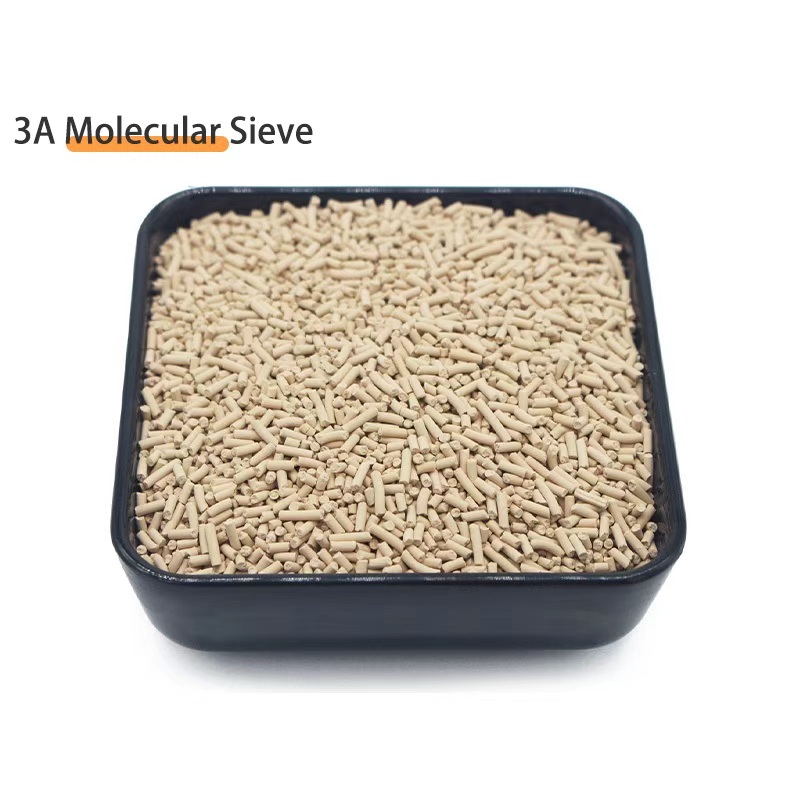
Molecular Sieve 3A / 4A / 5A / 13X
Type 3A, 4A, 5A and 13X zeolite with a certificate of analysis and MSDS on every shipment, lot-level traceability, and order quantities from 1 MT up to full-container tonnage with standard export packaging.
View Product Details →Next steps
Put your actual numbers into the frame above rather than arguing from a price list. Work out the tonnage of your next order as a number of complete adsorber bed loads, check what fill factor your packaging and grade give you in a 40 ft box, and calculate what the extra inventory would cost at your own storage and capital rates. That gives you a specific quantity with a technical justification, a far stronger opening position than "can you do 18 MT instead of 25 MT". Then put three requests on the table in one message: standard packaging instead of custom, a split delivery against a single order, and a price quotation at your proposed quantity.
Send us your current specification, your annual consumption and your container constraints, and we will quote the quantity that actually fits your operation rather than the quantity that suits ours, and tell you plainly where the real limit sits: production campaign, export economics, or packaging format.
Send us your specification and your annual consumption. We will work out the order quantity that fits your bed loads and container fill, quote it at the volume that quantity supports, and flag any specification line that would move the minimum.